The Science Behind Structured vs. Unstructured Play

The Science Behind Structured vs. Unstructured Play
Why children need both — and how Peacock Learning Academy balances them for optimal development
When families first explore early learning options, one of the most common questions they ask is: “Do you focus more on structured learning or unstructured play?”
The truth is, high-quality early childhood education requires both — in purposeful balance.
At Peacock Learning Academy, we use the Early Learning Experience curriculum to carefully integrate structured play and unstructured play throughout the day. Each serves a unique, research-supported role in how children learn, build confidence, and develop foundational life skills.
This is not just philosophy — it’s neuroscience and decades of child development research.
What is structured vs. unstructured play?
Structured Play
Structured play involves adult-designed activities with clear goals or rules. Educators choose the materials, environment, and learning objective — then guide children through the experience.
Examples:
- Small-group math centers
- Pattern-matching games
- Music and movement sessions
- Teacher-modeled science experiments
- Fine-motor practice with scissors or writing tools
The outcomes are intentional: new vocabulary, numeracy skills, motor coordination, memory strategies, etc.
Unstructured Play
Unstructured play is child-directed, open-ended, and spontaneous. Children decide how they play, what materials they use, and how long they explore.
Examples:
- Free choice centers
- Block building with no specific goal
- Pretend restaurant or doctor’s office
- Outdoor climbing and imaginative games
Here, children take the lead — experimenting, negotiating with peers, solving problems, and expressing creativity.
Why children need structured play
Structured learning is essential for building school-readiness skills. It’s where children are introduced to concepts, language, and processes that will set them up for success in kindergarten and beyond.
Research highlights:
- Small-group, teacher-guided instruction significantly improves early literacy and math outcomes (early numeracy studies, emergent literacy research).
- Guided play strengthens working memory, attention, and the ability to follow multi-step directions — key components of executive function.
- Structured practice with tools like scissors, writing utensils, and puzzles develops fine motor control needed for early handwriting and independence tasks.
When teachers structure learning with intention — not rigidity — children build both cognitive and motor skills efficiently.
In short: Structured play creates skill builders.
Why children need unstructured play
Unstructured play supports children’s intrinsic motivation, autonomy, social-emotional growth, creativity, and flexible thinking. It’s where children become leaders in their own learning.
Research highlights:
- Free play fosters creativity, imagination, and problem-solving — all tied to long-term innovation skills.
- Social pretend play improves cooperation, empathy, conflict resolution, and self-regulation (foundational SEL development).
- Neuroscience shows open-ended exploration supports brain plasticity — children build neural pathways for decision-making and resilience.
- Outdoor unstructured play supports risk assessment skills and advances gross motor development.
Unstructured play allows children to test ideas, take appropriate risks, and make mistakes safely — which builds genuine confidence.
In short: Unstructured play creates thinkers, collaborators, and self-motivated learners.
How each supports different developmental domains
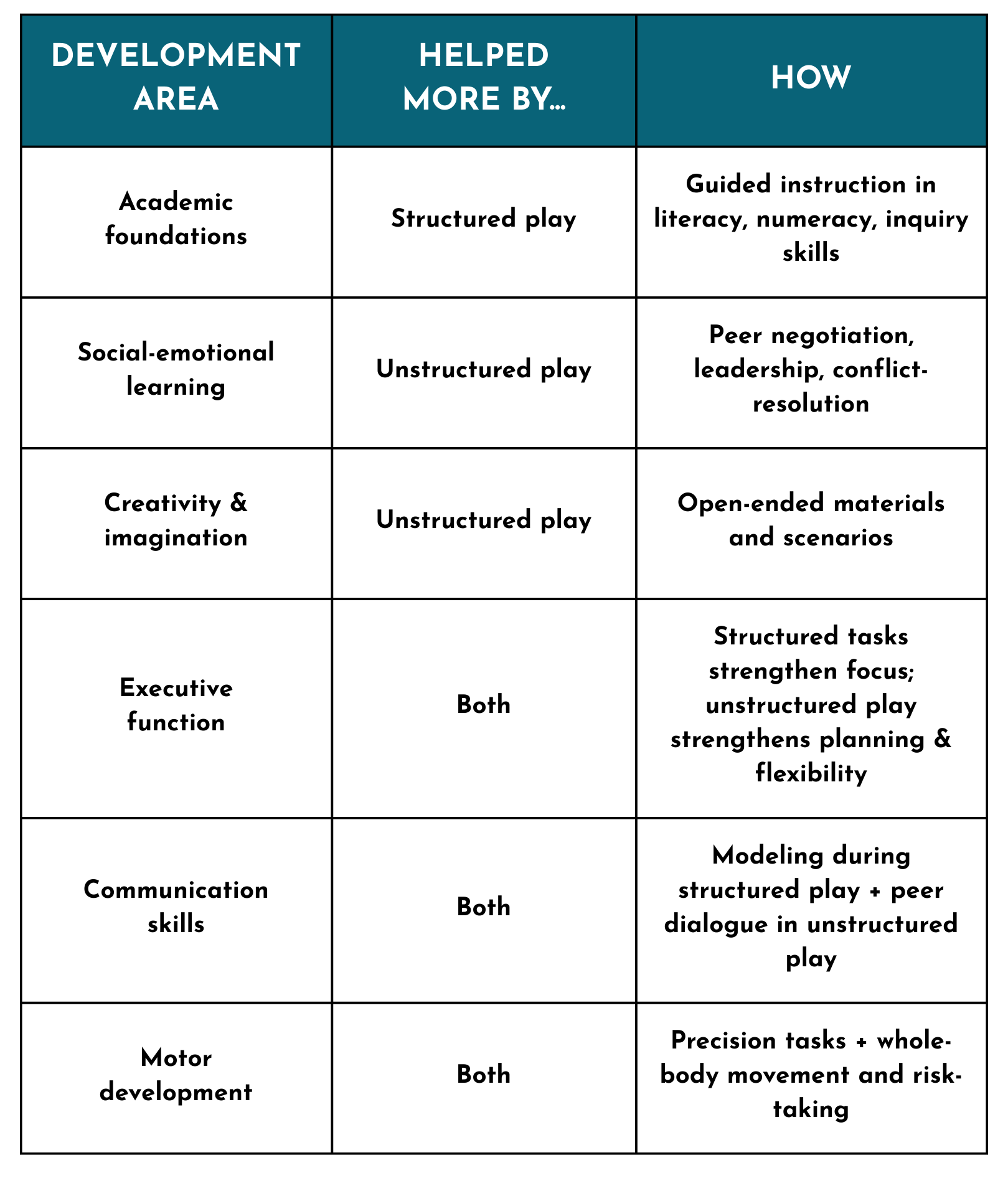
Balance is the key. Too much structure limits creativity. Too much free play may leave skill gaps.
Guided play: the bridge between both worlds
There’s growing research on guided play — playful experiences initiated by the child but enriched and subtly scaffolded by adults.
Examples at Peacock:
- A child decides to build a bridge → A teacher asks, “What could make it stronger?” and introduces vocabulary like stable, balance, support.
- Children pretend to run a store → A teacher supplies coins and prompts counting and categorizing.
- Children explore water play → A teacher encourages predictions: “Which object do you think will sink? Why?”
Research shows guided play can produce equal or better academic outcomes as direct instruction — while preserving children’s joy, autonomy, and motivation.
The science behind why balance works:
Brain research demonstrates that both hemispheres and multiple cognitive networks activate differently depending on the type of play:
Structured play:
- Stimulates regions linked to working memory, attention, sequencing, and goal-directed behavior.
- Helps strengthen neural efficiency for foundational academic learning.
Unstructured play:
- Activates creativity networks, divergent thinking pathways, and the default mode network, which supports emotional processing.
When children alternate between the two, they:
- Strengthen every major cognitive system
- Learn when to follow structure and when to lead
- Build flexibility — a predictor of long-term success
This balance supports whole-child development — not just school readiness, but life readiness.
What this looks like at Peacock Learning Academy
Our daily schedule is intentionally designed to give children both types of play experiences, in rich and meaningful ways.
A day may include:
- Morning Meeting — structured circle time focused on communication and community skills
- Small-Group Instruction — structured math, literacy, or fine-motor skill-building
- Learning Centers + Dramatic Play — unstructured or guided play with teacher support nearby
- Outdoor Exploration — unstructured physical play with imaginative peer collaboration
- STEM Invitations — guided discovery with materials like ramps, magnets, or water tools
- Read-Aloud & Reflection — structured literacy with comprehension conversations
Our educators are trained observers. They intentionally step in when scaffolding is needed — and step back when children are leading their own learning.
Family benefits: understanding the balance
Parents often associate “real learning” with structured tasks like worksheets or teacher-led lessons. We help families see that:
- When children solve a dispute over a toy — they’re learning conflict resolution.
- When they build a tall tower — they’re working on physics and engineering concepts.
- When they draw stories — they’re developing early literacy foundations and fine motor pathways.
We partner with families to reinforce these ideas through:
- Portfolios showing both structured and unstructured achievements
- Home activities that mirror classroom balance
- Parent education blogs and family engagement events
The ultimate goal: confident, capable, curious learners
Children who are only exposed to structure may:
- Rely too heavily on adult direction
- Hesitate to try new things
- Struggle with problem-solving
Children who only engage in unstructured play may:
- Lack the foundational academic skills needed in kindergarten
- Struggle with transitions and expectations
- Miss opportunities for targeted skill development
Children who experience both thrive — academically, socially, and emotionally.
That is the outcome Peacock Learning Academy is proud to deliver.
Final takeaway
Structured play builds skills.
Unstructured play builds thinkers.
Guided play brings them together.
The science is clear: a balanced play-based curriculum is the most powerful approach for early learning. At Peacock Learning Academy, we design every day to ensure children grow into independent, curious, strong problem-solvers — not just ready for kindergarten, but ready for life.
Resources:

Sejal Dave, Owner and Director
Peacock Learning Academy